
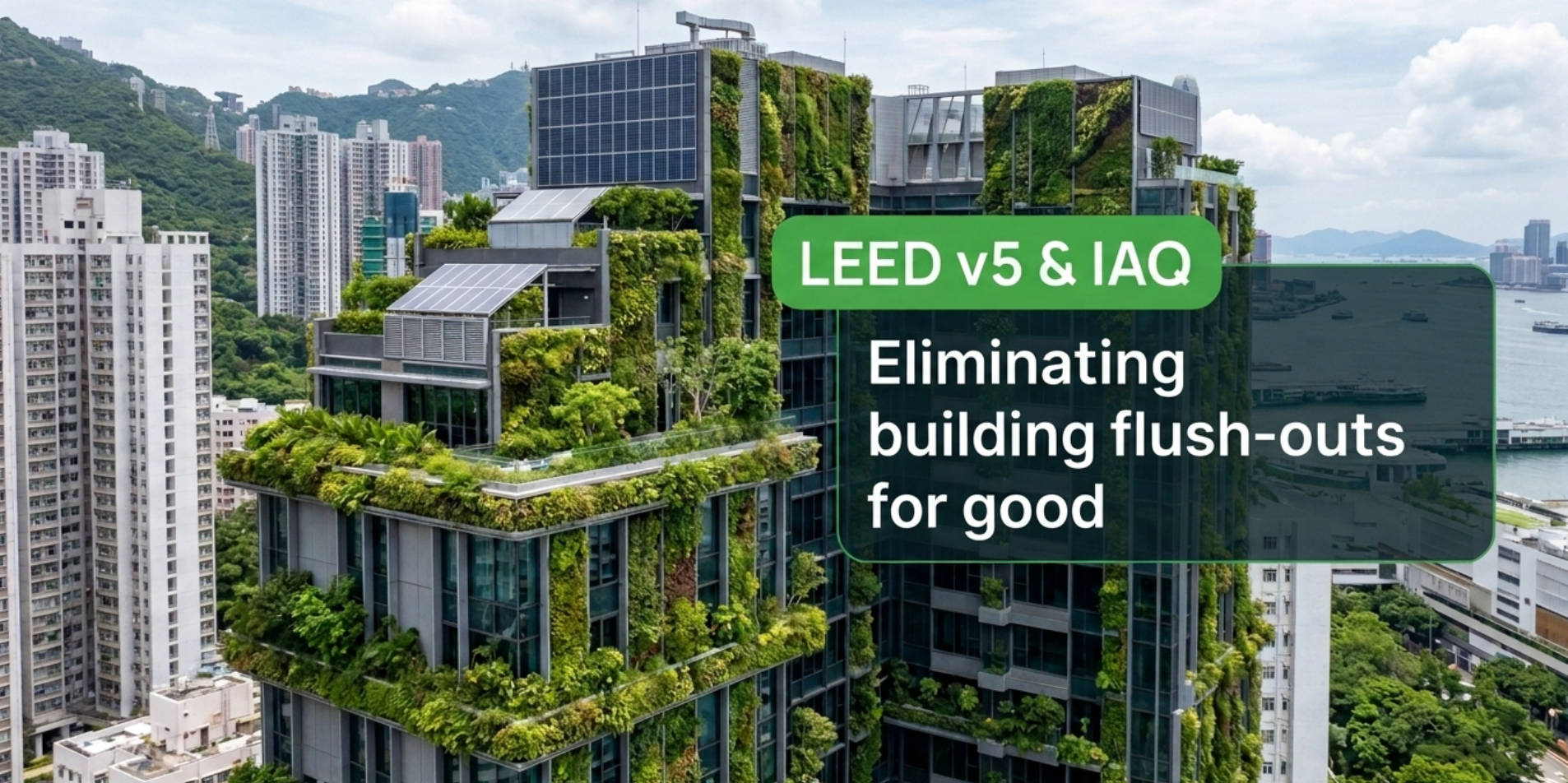
Leadership in Energy and Environmental Design (LEED) v5 removes building flush-outs as a compliance pathway, replacing them with regulatory, performance-based pre-occupancy indoor air quality (IAQ) testing. For real estate developers and architects committed to sustainable building initiatives, this shift requires adopting data-driven testing protocols. Project teams must actively measure contaminants to achieve certification under the new standards.
| Key Takeaways: LEED v5 IAQ Testing Requirements Major Change: LEED v5 eliminates building flush-outs entirely, replacing them with mandatory performance-based pre-occupancy IAQ testing. Why the Shift: Flush-outs only dilute air without proving it’s actually safe. They can’t verify contaminant removal and may introduce external pollutants, especially in urban or arid climates. Bottom Line: LEED v5 requires verifiable data over assumptions — compliance now means proven air quality through scientific measurement, not passive ventilation. |
Why Did LEED v5 Replace the Flush-Out Method?
The flush-out method involves pushing massive volumes of outdoor air through a newly constructed property to dilute and remove indoor air contaminants. LEED v5 replaced this practice because passive dilution cannot guarantee actual air quality or occupancy safety.
Flush-outs operate on the assumption that high volumes of air would clear out volatile organic compounds (VOCs) and construction debris. However, without laboratory analysis or direct-read instruments, developers have no empirical proof that the space is safe for occupancy.
Relying solely on outdoor air can expose interiors to external pollutants, especially in arid climates such as the Middle East or in dense urban centers like Hong Kong. Simple ventilation cannot always clear the microscopic hazards generated during the building phase. For example, fine particulate matter such as silica dust can linger long after construction, settling deep within ventilation systems, carpets and porous materials.
How Do LEED v5 Requirements Compare to LEED v4?
The shift from LEED v4 to LEED v5 marks a move from assumed compliance to verified performance. It requires proactive source control and precise testing schedules.
| Feature | LEED v4 / v4.1 | LEED v5 |
| Primary verification method | Uses baseline IAQ testing or flush-outs. | Flush-out eliminated. Requires performance-based, pre-occupancy testing or continuous indoor air monitoring. |
| Timeline impact | Flush-outs often delay occupancy due to the time required to cycle large volumes of outdoor air. | Testing occurs after construction and before occupancy. Path 1 includes direct-reading instruments that require a minimum 4-hour test and provide immediate results. |
| Cost and budget | Perceived as low up-front cost, but incurred high energy expenses to condition massive volumes of outdoor flush-out air. | Requires budget allocation for accredited laboratories or continuous monitors, trading higher up-front investment for verifiable data. |
| Containment focus | General compliance approach demonstrating acceptable IAQ prior to occupancy. | Splits points into specific paths with strict health-based limits for particulate matter (PM2.5/PM10) and inorganic gases, plus a separate point for target VOCs. |
Under v4, project teams could build with standard materials and attempt to air out the chemical off-gassing later. Under v5, the strict limits for VOCs and particulate matter mean that material selection is now critical to passing tests.
To avoid failing the updated IAQ assessments, architects and developers must choose high-performance building envelope designs and foundational materials from the outset. For example, using precast concrete that has a reduced water-to-cement ratio creates a tighter thermal envelope. It also prevents moisture transfer in the building.
What Are the Two Pre-Occupancy Testing Paths?
Under the LEED v5 framework, project teams must demonstrate measurable compliance through precise, scientific testing rather than estimated ventilation times. They must navigate two pre-occupancy testing pathways, each targeting various categories of airborne pollutants.
Path 1 — Real-Time Direct Instruments
This pathway focuses on measuring particulate matter like PM2.5 and PM10 and inorganic gases, such as carbon monoxide and ozone. Testing must occur over a minimum of four hours using accurate, calibrated sensors. This path offers immediate results as data collection happens in real time.
Path 2 — Laboratory VOC Analysis
The second pathway targets VOCs that off-gas from building materials and interior finishes. Air samples must be collected on-site and sent to an accredited laboratory for thorough analysis. This test screens for total VOCs as well as specific hazardous compounds, such as formaldehyde and benzene.
Navigating these testing paths requires sophisticated equipment and specialized knowledge. Professionals must partner with accredited, third-party testing organizations to ensure properties comply with the LEED IAQ requirements upheld by the U.S. Green Building Council (USGBC).
Managing the timing of these tests is also a crucial logistical component. Baseline IAQ testing must take place after all construction activities end, but before tenants move in. However, the rating system provides slight flexibility for specific commercial spaces. For example, retail projects are permitted to conduct the IAQ testing within 14 days of occupancy under typical ventilation conditions.
How Will the New Requirements Affect Timelines and Budgets?
Unlike the continuous, passive nature of a flush-out, pre-occupancy testing requires dedicated scheduling windows. While Path 1 provides rapid results in a few hours, Path 2 requires days for laboratory processing. Construction managers must build this waiting period into the timeline, alongside buffer days in case a test fails and requires source identification, remediation and retesting.
Flush-outs carried high hidden costs due to the energy required to run heating, ventilation and air conditioning (HVAC) systems at full capacity for extended periods. LEED v5 shifts this financial burden. Budgets must now be reallocated away from utility costs and directed toward hiring accredited IAQ testing professionals and laboratories.
Beyond one-time pre-occupancy testing, building owners are adopting air quality strategies to protect their assets in the long term. Some install permanent, building-grade air sensors. These smart systems continuously monitor and record pollutant concentrations in real time, alerting facility managers the moment air quality dips to unhealthy levels. By proactively monitoring carbon dioxide, particulates and humidity, stakeholders reduce operational liability and maintain a pristine environment throughout the building’s life cycle.
How Does Verifiable Data Shape the Future of Building Health?
Sustainable building remains the definitive path forward for commercial real estate. By eliminating the outdated flush-out method, LEED v5 ensures stakeholders actively measure, verify and manage indoor air quality continuously. Embracing these testing standards protects occupant health while enhancing the long-term marketability of global property developments. Verified air quality metrics transform commercial buildings into resilient, future-proofed assets.